


Springbrook National Park
For those seeking out the best that nature has to offer, Springbrook National Park is sure to impress. Containing some of the most stunning forestries you’ll find in the country, there are moments of pure bliss and jaw-dropping amazement to be found in this wondrous region.
Of all the places that could lay claim to possessing the most awe-inspiring rainforests within Australia, few can match the powerhouse of natural wonder to be found within Springbrook National Park. The reason behind the stunning inherent qualities stems from the fact that the entire region is based on the remnants of an ancient volcano.
Springbrook National Park rests on the slope of what is known as the Scenic Rim — a giant volcanic crater with a diameter of over 30 kilometres. Despite being relatively close to the coast, this mountain wilderness rises between 600 to 1,000 metres above sea level and can be cool even in the middle of summer.
The region receives on average more than 3,000 millimetres of rain a year in the wet season — most of which falls between the summer months of December and March. Combined with a variety of soil types this has created a fairytale playground of beautiful native vegetation.
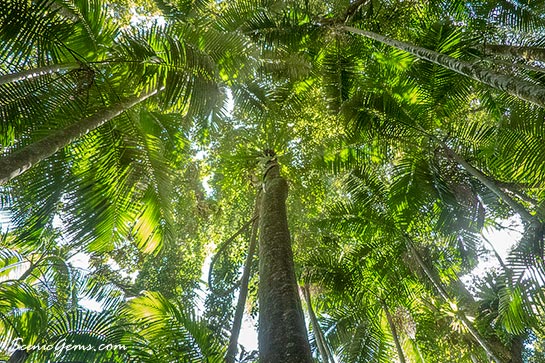
Within the park’s borders, you’ll find cool temperate, warm temperate and sub-tropical rainforest all existing within a relatively small area. Tall trees dominate, with some of the most significant examples of Australian species to be uncovered here. Combined with grand rhyolite escarpments of a volcanic past, it all adds up to one heck of an experience for those passing through.



Perhaps one of the best features of Springbrook National Park is its accessibility. It takes under one hour to reach the national park from the heart of the Gold Coast, so if you plan on enjoying the many beautiful beaches to be found along the coastline, the national park can be comfortably experienced as a day trip.
Run by national parks, there is one campground within Springbrook. The Settlement camping area is close to all the national park has to offer. For those looking for powered sites or who have a caravan in tow, you’ll need to base yourself on the Gold Coast as this campsite is not suitable for this travel style. Having said that though, nearly all of the roads within the national park are sealed, so getting in and around the park is straightforward.
As you’ll soon see, the attractions to be uncovered within Springbrook are world-class, so if you’re planning on travelling through the south-eastern corner of Queensland, be sure to consider this captivating national park as it’s one of the better ones you’ll find in the country.
Deep within Springbrook National Park, Natural Bridge is one of those rare nature-based attractions that is so incredibly beautiful and so unique, that words and pictures will never do justice to the overall experience. The Natural Bridge is a naturally-formed rock arch over Cave Creek. It was formed when the creek’s watercourse exposed a pothole in the rock above the cave system. The waterway now flows entirely through the hole — and what a sight it is to experience first-hand.
Receiving the lion’s share of the rainfall within the park, the forest surrounding Natural Bridge is the other standout attraction to be discovered here. It’s a fairytale environment and a glimpse into just how good rainforest can be.
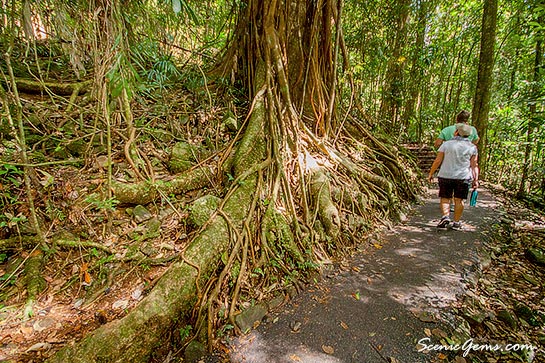
As you meander along, huge strangler figs are at every twist and turn. These magnificent trees are so named as they do indeed strangle. Courtesy of bird droppings, they start as seedlings lodged in the nooks of established trees. Over the course of hundreds of years, these tiny saplings make roots down to the forest floor, at which point they continue to grow until they swallow their host tree. If you’ve never seen a strangler fig before you’ll be in for a treat, as their huge presence is in ample supply here.


For those keen to check out all that Natural Bridge has to offer, you’ll be pleased to know that there is more to discover. The cave of Natural Bridge is the perfect environment for not one, but two of Australia’s more elusive creatures.
Each night on fading light, a colony of microbats make their way from deep within the cave walls and out into the night sky. If you happen to be here at dusk, standing at the mouth of the cave is an experience in itself as these tiny bats whiz past at blinding speed.
Not to be outdone, the cave is also home to a thriving colony of glow worms. Found only in Australia and New Zealand, these bioluminescent creatures are so small that they can’t be seen during daylight. Under the cover of darkness, it is an entirely different story as their green glow lights up the internal walls of the cave like stars in the night sky. You’ll also discover them under the shade of logs and tree roots on the trail down to the cave, which transforms the experience into a walk through an enchanted forest. It’s a fascinating phenomenon and, combined with Natural Bridge itself, makes this special place a stand out attraction of the park.
Note: The glow worms are at their brightest during the warmer months.
Grade: Easy/moderate (some stairs), 1km loop. Facilities: Public toilets and picnic tables.
Waterfalls are a feature of Springbrook National Park with the stunning water cascades at Purling Brook Falls no exception. With a single drop of a little over one hundred metres, it’s a substantial waterfall that’s not to be missed if you’re planning to visit.
Seeing Purling Brook Falls is achievable for people of all ages and abilities, depending on how close you wish to get. From the carpark, visitors are first greeted with the Gwongorella Picnic Area which has numerous secluded picnic tables amid gorgeous bushland. From the picnic area, walk down to the escarpment and you’ll soon be standing at any one of several vantage points to take in the enormity of the Purling Brook Falls and the McPherson Range in which it resides.
For those who wish to get up close to this gushing masterpiece, the Purling Brook Falls Circuit is your ticket to standing at its base. While the walk is essentially a walk from the top of the range to the bottom, it proves to be highly scenic with lush sub-tropical vegetation to enjoy along the way.
Thanks to a zig-zagging trail down the face of the escarpment, it also never gets too steep and could be accomplished by most. There are 265 steps on this walk which won’t be for everyone, but if you complete the loop in a clockwise direction, most of these will be on the descent.


Once you reach the base of the falls, the grandeur of this natural phenomenon is a very humbling experience with heavy rain turning on the waterworks with added vigour. Some choose to scramble across the rocks to the base of the falls where the full force of this towering cascade can be felt, which can be a great way to capture the might of this magnificent waterfall.
From the base of the falls, those who are used to walking can optionally take the trail to Warringa Pool — a delightful waterhole complete with its own mini waterfall. If you’re looking to take a dip, this is the preferred option and will be a welcome relief before heading back out the way you came.
Once back at the base of Purling Brook Falls, the circuit heads back up to the escarpment via another track so that you don’t have to retrace your steps. Check out the map before you go to visualise the walk. Overall, this is high up on the list of things to do in Springbrook, so be sure to keep this one in mind.
Grade – Purling Brook Falls Circuit: Easy/moderate, 4km loop. Warringa Pool: Easy, additional 2.2km return. Facilities: Public toilets and picnic tables at Gwongorella Picnic Area.

With the previously-mentioned big-ticket attractions garnering the most interest (and crowds), those who are looking for more will be well rewarded along the Twin Falls walk. Indeed, there should be far more people taking on this delightful trail with not one, but two magnificent waterfalls to walk behind.
In a similar way to Purling Brook Falls, the trail for this walk starts at the top of the McPherson range before dropping down the face of the escarpment where an ultra dense and luscious section of forest awaits.
Via a well-constructed trail, it isn’t long before visitors experience the grace and beauty of Twin Falls. It’s a sizeable waterfall no doubt but is small enough to remain incredibly peaceful and atmospheric. The waterfall features a large expanse of water at its base — perfect for that much-needed dip when it’s hot. The best part about Twin Falls though would have to be the curtain of water that you’ll have the pleasure of walking behind. It’s a blissfully engaging event and will be remembered for a long time after you’ve visited.
At this point, you are neither at the top nor the bottom of the escarpment, but rather, half-way up the slope. Continuing, the trail is a spectacular meander along the face of the escarpment with a wondrous natural environment to enjoy. As you stroll along, you’ll find numerous examples of giant brush box trees which have been carbon dated at 1500 years, and what a sight they are to take in first-hand.

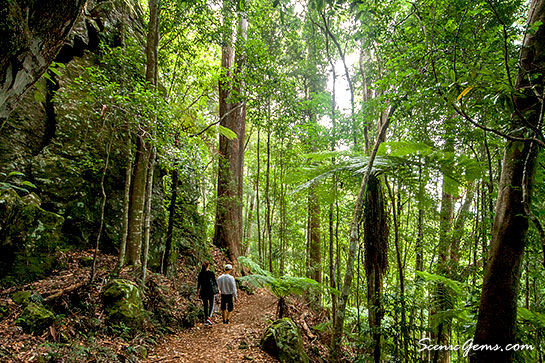

Continuing the walk is for the most part flat and easy-going as you take in the gorgeous scenery of the forest. Eventually, you’ll come to the second major waterfall to be discovered along the trail at Blackfellow Falls. In much the same fashion as Twin Falls, you’ll once again have the pleasure of walking behind these falls, and what a sensation it is.

Before long, you’ll be presented with an upshift in the trail which will take you back up to the top of the escarpment. You’ll then switch back along the ridgeline as you make your way back to the carpark and your starting location.
Before you get there though, you’ll have a few superb vantage points to take in the enormity of the McPherson Range, most of which have views that stretch all the way to the Gold Coast.

Of all the vantage points along the ridgeline, Canyon Lookout is arguably the most scenic and would be worth a look in itself. Fortunately, you can drive to a carpark that is situated only moments away, so if you’re short on time and can’t complete the walk, be sure to make a beeline for this amazing viewpoint as the scenery is divine.
Overall, if you’ve got the time to invest in all that Springbrook National Park has to offer, you’ll do well to complete the Twin Falls Circuit. Some have said that this was their favourite attraction of the park, which while subjective gives you an indication of the charm of this lesser-visited gem.
Grade: Easy/moderate, 4km loop. Facilities: Public toilets and picnic tables at Tallanbana Picnic Area (carpark).
In the introduction, we mentioned that Springbrook National Park resides on the slope of an ancient volcano. Now imagine at the top of this slope that you could stand on the volcanic rim — who’s diameter was some 30 kilometres wide. Welcome to Best of All Lookout.
Before we get to the lookout itself, the walk-in is just as much a feature as the vantage point. You see, the weather on the rim is quite a contrast to the slopes, with water-laden sea breezes condensing against the towering cliffs of the rim. As such, Best of All Lookout sees a vast amount of rain and fog and with it comes a completely different forest type.
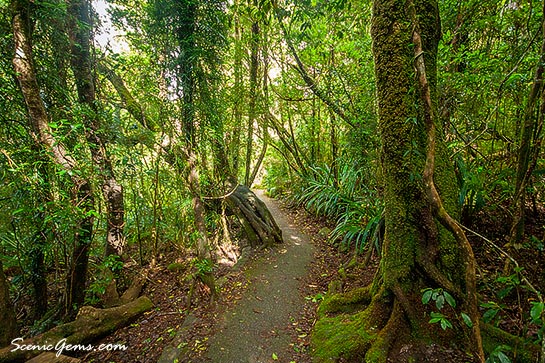
Here you will find a stand of ancient forest that stems back to the times of Gondwana — the name given to a time when Australia was connected to Antarctica. This landmass was much lower than where Australia rests today, and thus, was a much colder climate. Thanks to the unique microclimate at Best of All Lookout, an enchanted Gondwanan forest has been able to survive, which for those passing through can be a real highlight.
The stars of the show along the trail to the lookout are the huge Antarctic beech trees which inhabit the forest. They are said to be over 2000 years old. Perhaps even 2500-3000 years old. Covered in moss, their spectacular presence is deeply moving. Of the few places to see these trees in Australia, if you had to pick, the overall experience at Best of All Lookout is one of the best places to do so.


From the vantage point of Best of All Lookout, visitors can look across the vast expanse of an ancient erosion caldera. What is an erosion caldera? There are times when a volcano discharges a vast amount of magma from underneath the earth’s surface, creating a huge underground cavern. The cavern subsequently collapses, with a giant crater-like landform left in this event’s wake.
Standing on the edge of the rim, the views stretch for as far as the eye can see, with the coast seen on a clear day. Taking centre stage, Mount Warning rests in the very centre of the volcano. It is actually a gigantic volcanic plug, and what a sight it creates today.
Note: The lookout is often shrouded in cloud with next to no visibility due to fog. Midday to mid-afternoon is potentially the best time to come to the lookout. Having said that, if it is surrounded in fog the scenery on the walk through the forest to the lookout takes on a moody persona that can elevate the experience.
Grade: Easy, 700m return. Facilities: Note, there are no facilities.
